Nora
An AI styling assistant that recommends from what you own before what you could buy
Year
2025
Category
AI Product · Research · Ethical Design
Context
Design Fieldwork
/ Problem
Can AI Respect Identity?
Recommendation systems work by pattern-matching users to categories. In fashion, there is a specific cost to it: the system needs to decide what style you have before it suggests options, and once that decision is made, it shapes the next things you see.
Nora is built around a different premise. The application takes weather, occasion, and mood as inputs, returns three outfits drawn from what the user already owns, and learns from a binary signal - Did this feel right? Style labels the user chose for themselves act as a guiding input, with simple colour and style matching as the underlying logic. The category question is left open. The product expands what the user can see in their own closet rather than limiting them to a type.
What the Field Surfaces
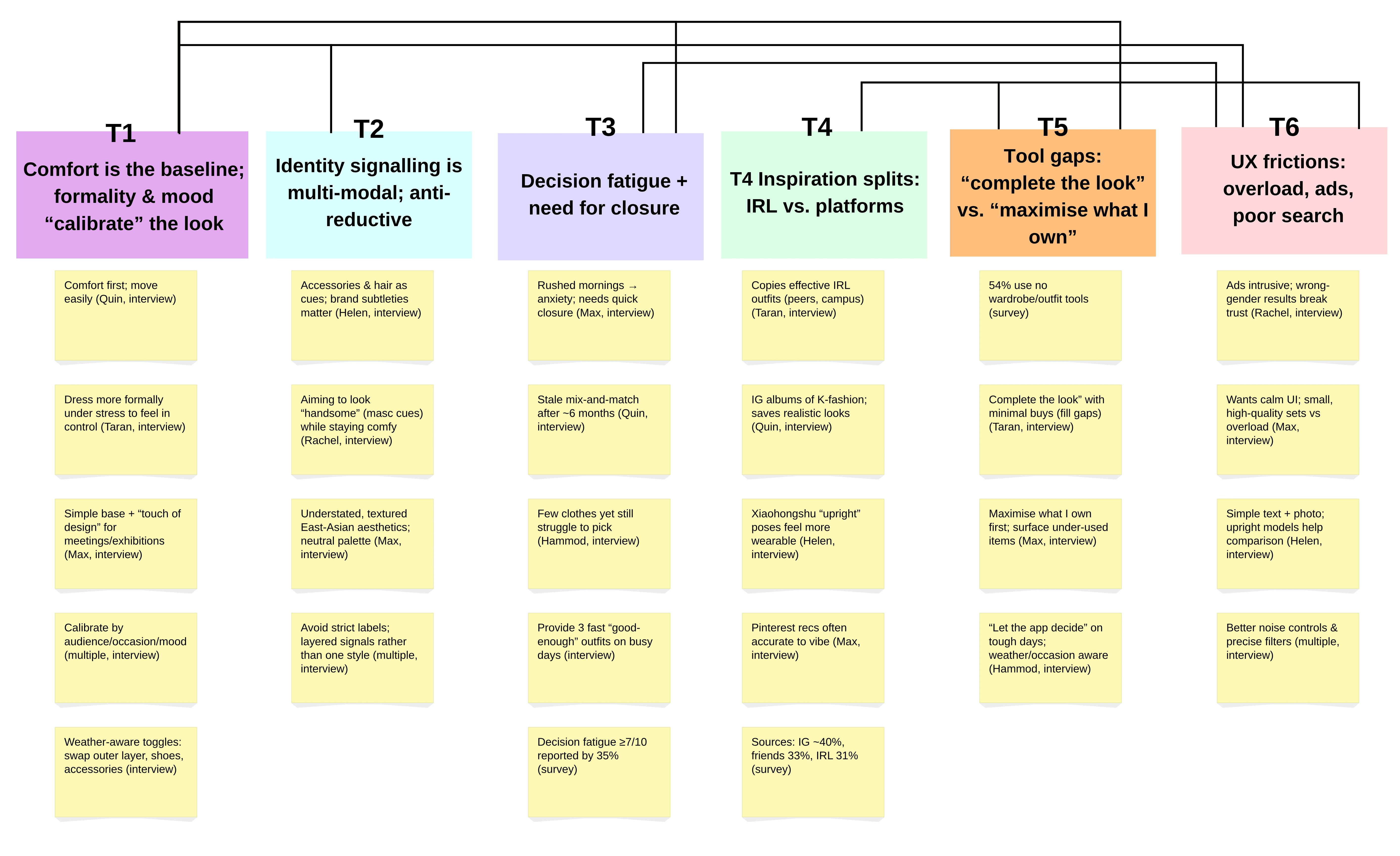
Ten interviews with young adults in Melbourne, plus a 48-response survey, were coded under reflexive thematic analysis into six themes. The result shaped the project anchor: identity expressions show up in subtle, combinatorial ways. Participants resisted being labelled into a single style.
They modulated signals: hair, accessories, silhouette, texture, across context, audience, and mood.
Thus, the product question shifted from how do we recommend outfits accurately, to how do we build an AI surface that supports combinatorial self-expression without collapsing it into a type while providing outfit recommendations.
/ Strategy
Two viable concepts were ruled out before prototyping. While both represent the standard playbook for fashion tech, they didn't hold up against users' daily life context.
01 . The Cataloger (Full Digitisation)
The Pitch: A comprehensive wardrobe cataloger. On paper, it makes sense, to solve dressing, you need to know exactly what the user owns.
The Friction: It turns a rushed morning into a data-entry chore, asking someone to photograph their clothes directly contradicts the rushed-morning context.
02 . The Social Layer (Peer Feedback)
The Pitch: Fashion is inherently expressive, so building a peer-to-peer feedback loop seemed like a natural way to drive engagement.
The Friction: Feeds introduce performance anxiety. A product built to lower cognitive load shouldn’t drag users back into digital noise.
/ Features
Three Outfits - Decision Fatigue in the Morning
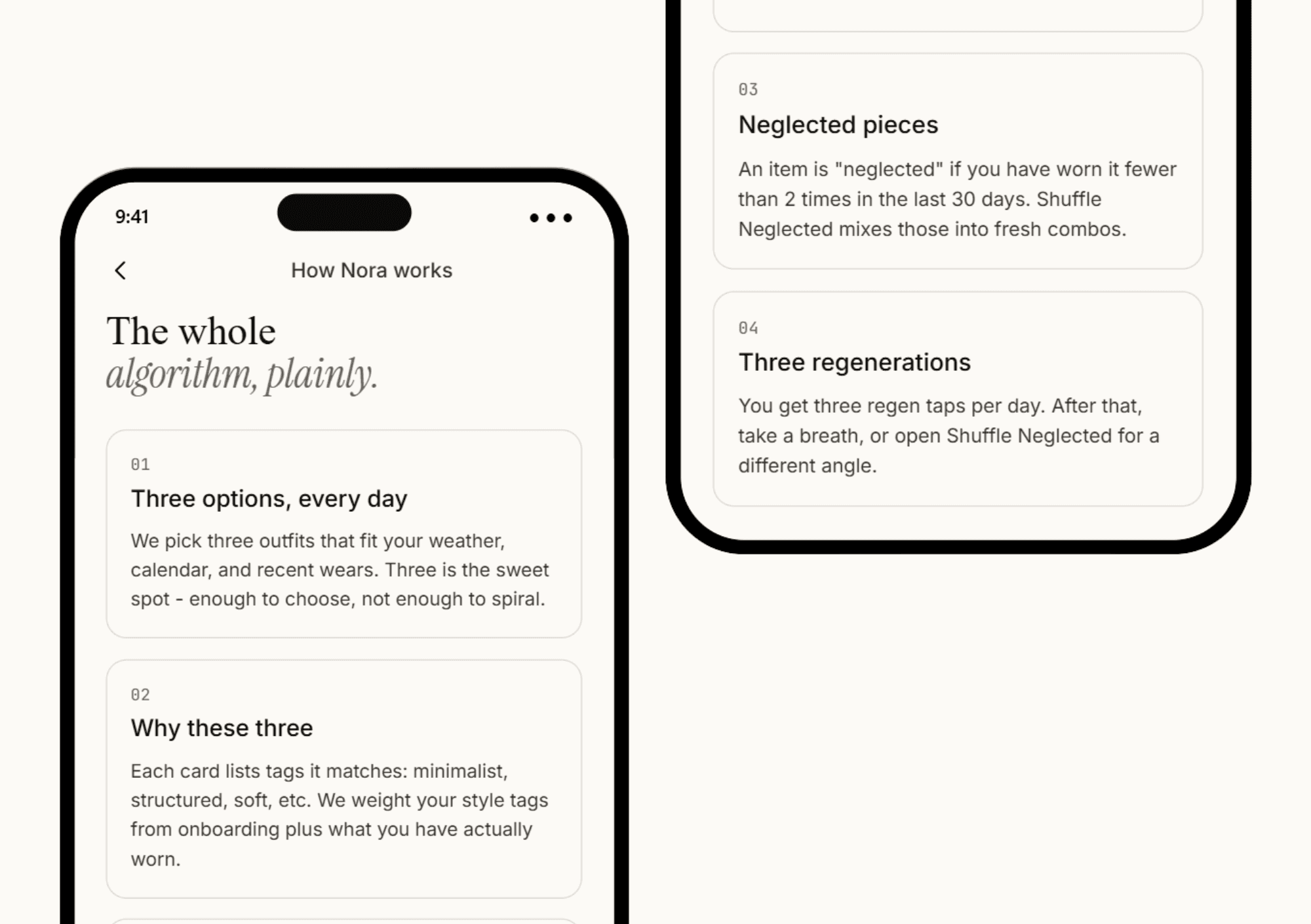
35% of respondents reported decision fatigue as a frequent trigger. The home screen returns three outfits per day, generated against weather, occasion, and mood. Too many suggestions would trigger analysis paralysis. Thus, three preserves agency without overwhelming a user with 90 seconds before they need to leave. The regenerate function caps at three; past that, more options start becoming the new fatigue for users who need quick decisions.
The "Feel Right?" rating below each outfit is binary by design, not enough resolution to capture style cleanly, but enough to keep the feedback loop honest without demanding emotional labour at 8:40 AM.
Shuffle Neglected - A Recommendation Engine for Rediscovery
Across interviews, users described owning items they had functionally forgotten. One participant called it stale-wardrobe paralysis.
Another user explicitly asked "help me maximise what I already own instead of pushing new things."
Shuffle Neglected pushes what the user already owns but functionally forgot instead of buying more. The conceptual move is an inversion. Apps typically bury low-usage data in analytics dashboards. To solve this, Nora makes it the call-to-action: "You have 8 items worn fewer than 2 times." The app then builds three outfits around those pieces, with a loading state that reads "Mixing forgotten pieces with your favourites", the algorithmic logic announced before the result.
Complete-the-look - Ads Break Trust
Users asked for purchase suggestions to fill missing pieces. The risk was that styling app that recommends purchases becomes a shopping app, and the trust collapses immediately.
Complete-the-look is reachable, but only after the user views wardrobe options first. Alternatives appear with transparent sourcing, "Don't have Black Boots? Try these instead", and a clear path back to the original outfit. Direct in-app purchasing was deliberately excluded. Recommending what to wear and selling what to wear are different categories, and the trust failures users described came from apps that had merged them.
Saved & Inspiration - Style Data is Intimate
The feature exists because the field surfaced something the engine couldn't replicate: people get dressed partly from things they noticed in the world. A stranger's outfit on the street. A photo saved from a friend's feed. The pull happens before any app has a chance to suggest anything.
Saved has both: Outfits the user wore, and Inspiration collected from elsewhere, preserving the human signal that comes before the algorithmic one. Inspiration informs future recommendations on the user's device without being shared or used to train a model.
/ Result
A few decisions in Nora exist to limit what the product can do.
It rejects the output of the "you are this type of style" summary screen. The product avoids telling users who they are. The recommendation system gets sharper the more they decide who you are, and a styling app that gets too sharp starts shaping what users consider wearing.
The buy path is reachable, but only after wardrobe-first options. Direct purchasing and AR try-on were excluded. A styling app and a shopping app are different products, separating utility from consumption.
None of this resolves the underlying tension. Recommending purchases at all sits awkwardly next to a wardrobe-utilisation product. A model trained on existing fashion data inherits its defaults: Western, corporate, gendered, and the bias is embedded in the data itself, not solvable yet at the interface layer.
Nora's contribution isn't in resolving these tensions, but in the refusal to design as if they weren't there. The model layer, how the system understands taste, is where the next round will be.
Nora
An AI styling assistant that recommends from what you own before what you could buy
Year
2025
Category
AI Product · Research · Ethical Design
Context
Design Fieldwork
/ Problem
Can AI Respect Identity?
Recommendation systems work by pattern-matching users to categories. In fashion, there is a specific cost to it: the system needs to decide what style you have before it suggests options, and once that decision is made, it shapes the next things you see.
Nora is built around a different premise. The application takes weather, occasion, and mood as inputs, returns three outfits drawn from what the user already owns, and learns from a binary signal - Did this feel right? Style labels the user chose for themselves act as a guiding input, with simple colour and style matching as the underlying logic. The category question is left open. The product expands what the user can see in their own closet rather than limiting them to a type.
What the Field Surfaces
Ten interviews with young adults in Melbourne, plus a 48-response survey, were coded under reflexive thematic analysis into six themes. The result shaped the project anchor: identity expressions show up in subtle, combinatorial ways. Participants resisted being labelled into a single style.
They modulated signals: hair, accessories, silhouette, texture, across context, audience, and mood.
Thus, the product question shifted from how do we recommend outfits accurately, to how do we build an AI surface that supports combinatorial self-expression without collapsing it into a type while providing outfit recommendations.
/ Strategy
Two viable concepts were ruled out before prototyping. While both represent the standard playbook for fashion tech, they didn't hold up against users' daily life context.
01 . The Cataloger (Full Digitisation)
The Pitch: A comprehensive wardrobe cataloger. On paper, it makes sense, to solve dressing, you need to know exactly what the user owns.
The Friction: It turns a rushed morning into a data-entry chore, asking someone to photograph their clothes directly contradicts the rushed-morning context.
02 . The Social Layer (Peer Feedback)
The Pitch: Fashion is inherently expressive, so building a peer-to-peer feedback loop seemed like a natural way to drive engagement.
The Friction: Feeds introduce performance anxiety. A product built to lower cognitive load shouldn’t drag users back into digital noise.
/ Features
Three Outfits - Decision Fatigue in the Morning
35% of respondents reported decision fatigue as a frequent trigger. The home screen returns three outfits per day, generated against weather, occasion, and mood. Too many suggestions would trigger analysis paralysis. Thus, three preserves agency without overwhelming a user with 90 seconds before they need to leave. The regenerate function caps at three; past that, more options start becoming the new fatigue for users who need quick decisions.
The "Feel Right?" rating below each outfit is binary by design, not enough resolution to capture style cleanly, but enough to keep the feedback loop honest without demanding emotional labour at 8:40 AM.
Shuffle Neglected - A Recommendation Engine for Rediscovery
Across interviews, users described owning items they had functionally forgotten. One participant called it stale-wardrobe paralysis.
Another user explicitly asked "help me maximise what I already own instead of pushing new things."
Shuffle Neglected pushes what the user already owns but functionally forgot instead of buying more. The conceptual move is an inversion. Apps typically bury low-usage data in analytics dashboards. To solve this, Nora makes it the call-to-action: "You have 8 items worn fewer than 2 times." The app then builds three outfits around those pieces, with a loading state that reads "Mixing forgotten pieces with your favourites", the algorithmic logic announced before the result.
Complete-the-look - Ads Break Trust
Users asked for purchase suggestions to fill missing pieces. The risk was that styling app that recommends purchases becomes a shopping app, and the trust collapses immediately.
Complete-the-look is reachable, but only after the user views wardrobe options first. Alternatives appear with transparent sourcing, "Don't have Black Boots? Try these instead", and a clear path back to the original outfit. Direct in-app purchasing was deliberately excluded. Recommending what to wear and selling what to wear are different categories, and the trust failures users described came from apps that had merged them.
Saved & Inspiration - Style Data is Intimate
The feature exists because the field surfaced something the engine couldn't replicate: people get dressed partly from things they noticed in the world. A stranger's outfit on the street. A photo saved from a friend's feed. The pull happens before any app has a chance to suggest anything.
Saved has both: Outfits the user wore, and Inspiration collected from elsewhere, preserving the human signal that comes before the algorithmic one. Inspiration informs future recommendations on the user's device without being shared or used to train a model.
/ Result
A few decisions in Nora exist to limit what the product can do.
It rejects the output of the "you are this type of style" summary screen. The product avoids telling users who they are. The recommendation system gets sharper the more they decide who you are, and a styling app that gets too sharp starts shaping what users consider wearing.
The buy path is reachable, but only after wardrobe-first options. Direct purchasing and AR try-on were excluded. A styling app and a shopping app are different products, separating utility from consumption.
None of this resolves the underlying tension. Recommending purchases at all sits awkwardly next to a wardrobe-utilisation product. A model trained on existing fashion data inherits its defaults: Western, corporate, gendered, and the bias is embedded in the data itself, not solvable yet at the interface layer.
Nora's contribution isn't in resolving these tensions, but in the refusal to design as if they weren't there. The model layer, how the system understands taste, is where the next round will be.
Nora
An AI styling assistant that recommends from what you own before what you could buy
Year
2025
Category
AI Product · Research · Ethical Design
Context
Design Fieldwork
/ Problem
Can AI Respect Identity?
Recommendation systems work by pattern-matching users to categories. In fashion, there is a specific cost to it: the system needs to decide what style you have before it suggests options, and once that decision is made, it shapes the next things you see.
Nora is built around a different premise. The application takes weather, occasion, and mood as inputs, returns three outfits drawn from what the user already owns, and learns from a binary signal - Did this feel right? Style labels the user chose for themselves act as a guiding input, with simple colour and style matching as the underlying logic. The category question is left open. The product expands what the user can see in their own closet rather than limiting them to a type.
What the Field Surfaces
Ten interviews with young adults in Melbourne, plus a 48-response survey, were coded under reflexive thematic analysis into six themes. The result shaped the project anchor: identity expressions show up in subtle, combinatorial ways. Participants resisted being labelled into a single style.
They modulated signals: hair, accessories, silhouette, texture, across context, audience, and mood.
Thus, the product question shifted from how do we recommend outfits accurately, to how do we build an AI surface that supports combinatorial self-expression without collapsing it into a type while providing outfit recommendations.
/ Strategy
Two viable concepts were ruled out before prototyping. While both represent the standard playbook for fashion tech, they didn't hold up against users' daily life context.
01 . The Cataloger (Full Digitisation)
The Pitch: A comprehensive wardrobe cataloger. On paper, it makes sense, to solve dressing, you need to know exactly what the user owns.
The Friction: It turns a rushed morning into a data-entry chore, asking someone to photograph their clothes directly contradicts the rushed-morning context.
02 . The Social Layer (Peer Feedback)
The Pitch: Fashion is inherently expressive, so building a peer-to-peer feedback loop seemed like a natural way to drive engagement.
The Friction: Feeds introduce performance anxiety. A product built to lower cognitive load shouldn’t drag users back into digital noise.
/ Features
Three Outfits - Decision Fatigue in the Morning
35% of respondents reported decision fatigue as a frequent trigger. The home screen returns three outfits per day, generated against weather, occasion, and mood. Too many suggestions would trigger analysis paralysis. Thus, three preserves agency without overwhelming a user with 90 seconds before they need to leave. The regenerate function caps at three; past that, more options start becoming the new fatigue for users who need quick decisions.
The "Feel Right?" rating below each outfit is binary by design, not enough resolution to capture style cleanly, but enough to keep the feedback loop honest without demanding emotional labour at 8:40 AM.
Shuffle Neglected - A Recommendation Engine for Rediscovery
Across interviews, users described owning items they had functionally forgotten. One participant called it stale-wardrobe paralysis.
Another user explicitly asked "help me maximise what I already own instead of pushing new things."
Shuffle Neglected pushes what the user already owns but functionally forgot instead of buying more. The conceptual move is an inversion. Apps typically bury low-usage data in analytics dashboards. To solve this, Nora makes it the call-to-action: "You have 8 items worn fewer than 2 times." The app then builds three outfits around those pieces, with a loading state that reads "Mixing forgotten pieces with your favourites", the algorithmic logic announced before the result.
Complete-the-look - Ads Break Trust
Users asked for purchase suggestions to fill missing pieces. The risk was that styling app that recommends purchases becomes a shopping app, and the trust collapses immediately.
Complete-the-look is reachable, but only after the user views wardrobe options first. Alternatives appear with transparent sourcing, "Don't have Black Boots? Try these instead", and a clear path back to the original outfit. Direct in-app purchasing was deliberately excluded. Recommending what to wear and selling what to wear are different categories, and the trust failures users described came from apps that had merged them.
Saved & Inspiration - Style Data is Intimate
The feature exists because the field surfaced something the engine couldn't replicate: people get dressed partly from things they noticed in the world. A stranger's outfit on the street. A photo saved from a friend's feed. The pull happens before any app has a chance to suggest anything.
Saved has both: Outfits the user wore, and Inspiration collected from elsewhere, preserving the human signal that comes before the algorithmic one. Inspiration informs future recommendations on the user's device without being shared or used to train a model.
/ Result
A few decisions in Nora exist to limit what the product can do.
It rejects the output of the "you are this type of style" summary screen. The product avoids telling users who they are. The recommendation system gets sharper the more they decide who you are, and a styling app that gets too sharp starts shaping what users consider wearing.
The buy path is reachable, but only after wardrobe-first options. Direct purchasing and AR try-on were excluded. A styling app and a shopping app are different products, separating utility from consumption.
None of this resolves the underlying tension. Recommending purchases at all sits awkwardly next to a wardrobe-utilisation product. A model trained on existing fashion data inherits its defaults: Western, corporate, gendered, and the bias is embedded in the data itself, not solvable yet at the interface layer.
Nora's contribution isn't in resolving these tensions, but in the refusal to design as if they weren't there. The model layer, how the system understands taste, is where the next round will be.