NIVA
Cross-Category Personalisation
Year
2026
Category
Creative Tech
Context
Independent R&D
/ Problem
The Articulation Gap
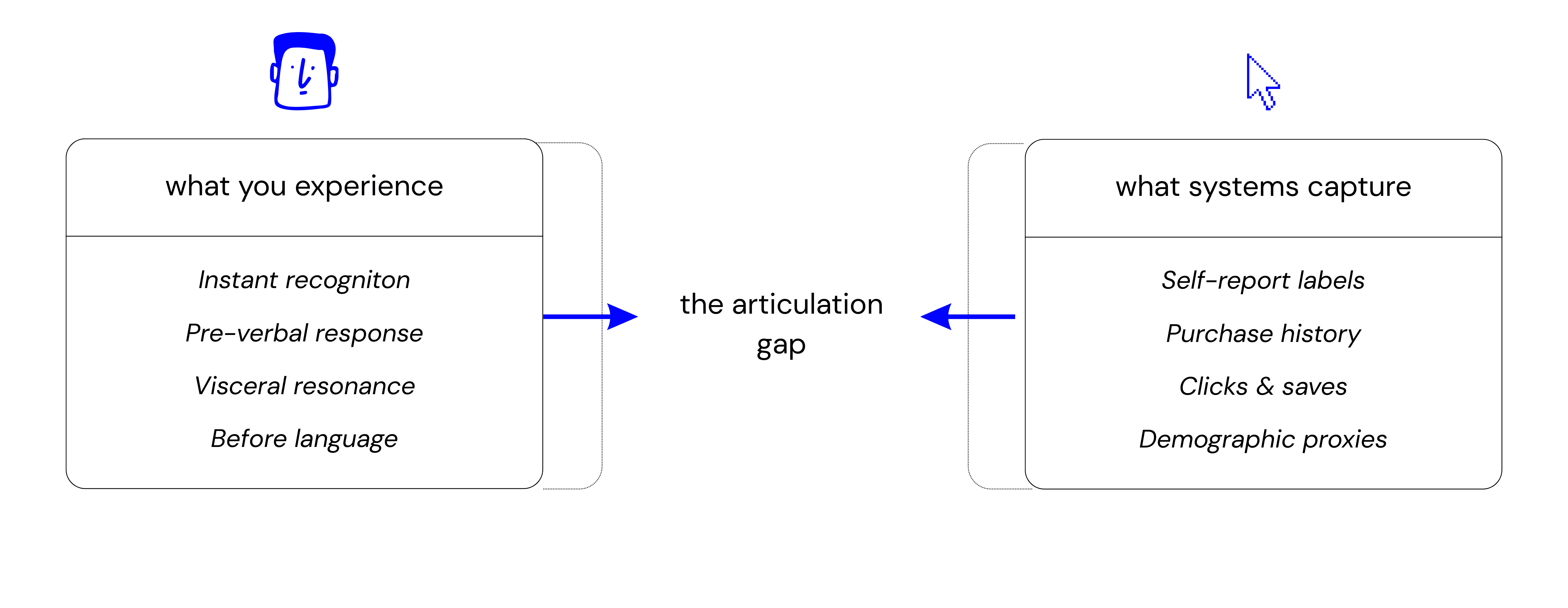
To explore our relationship with personal style and aesthetic, I initiated a research study comprising a survey of 50 participants and 10 in-depth interviews. The finding was that while people instinctively recognise what they love, they struggle to articulate and find objects/items that match it.
There's a strong desire to define and match their unique style, proving that while the instinct is deeply rooted, yet standard tools fall short in helping them break down, match, and interpret that intuitive taste.
Current recommendation systems haven't filled that gap yet. By modelling behaviour, clicks, purchases, and watch time, they flatten a person into their purchase history and cannot carry an aesthetic from one category to another. The tools that do attempt taste/style run a quiz and hand back one generic label: "minimalist," "boho," "maximalist." Broad style descriptors like 'minimalist' contain too much compressed data. They lack the granularity required to accurately match individual items, let alone capture a person's unique preferences.
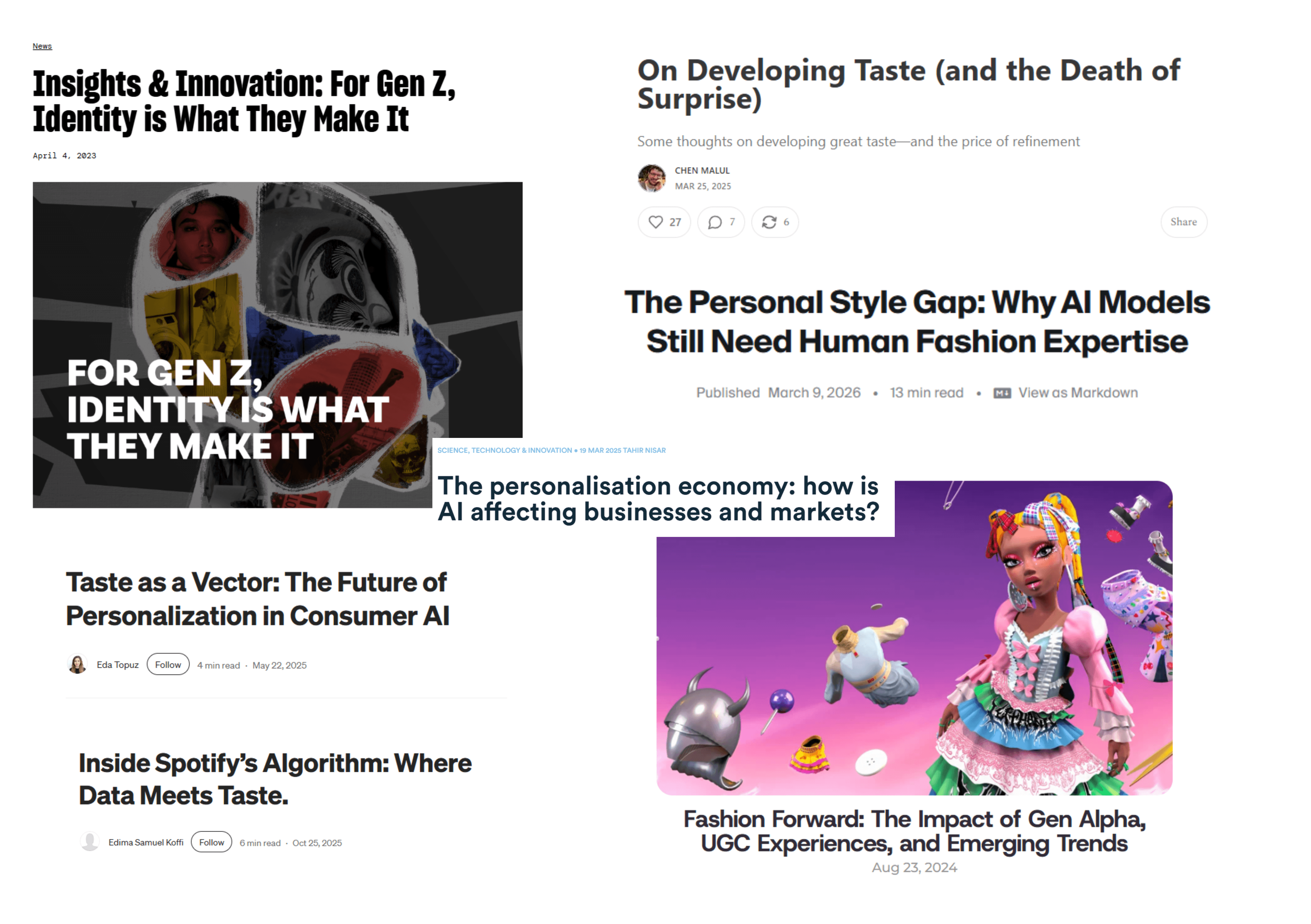
Current AI stylists often shift the burden to the user by requiring written descriptions, the exact friction point for most consumers. While industries like fintech and healthcare scale rapidly on structured data, fashion lacks a foundational data layer for taste. Yet, consumer demand for visual consistency is surging, driven by younger demographics who treat aesthetic as identity. Digital wardrobe utility is peaking with 236% growth in a year, with users even improvising tools inside basic note apps, screenshots to save inspiration and grow their personal style.
The demand exists, and the tools that exist serve inspiration more than decisions.
/ The Insights
Core Principles
Three positions were laid out.
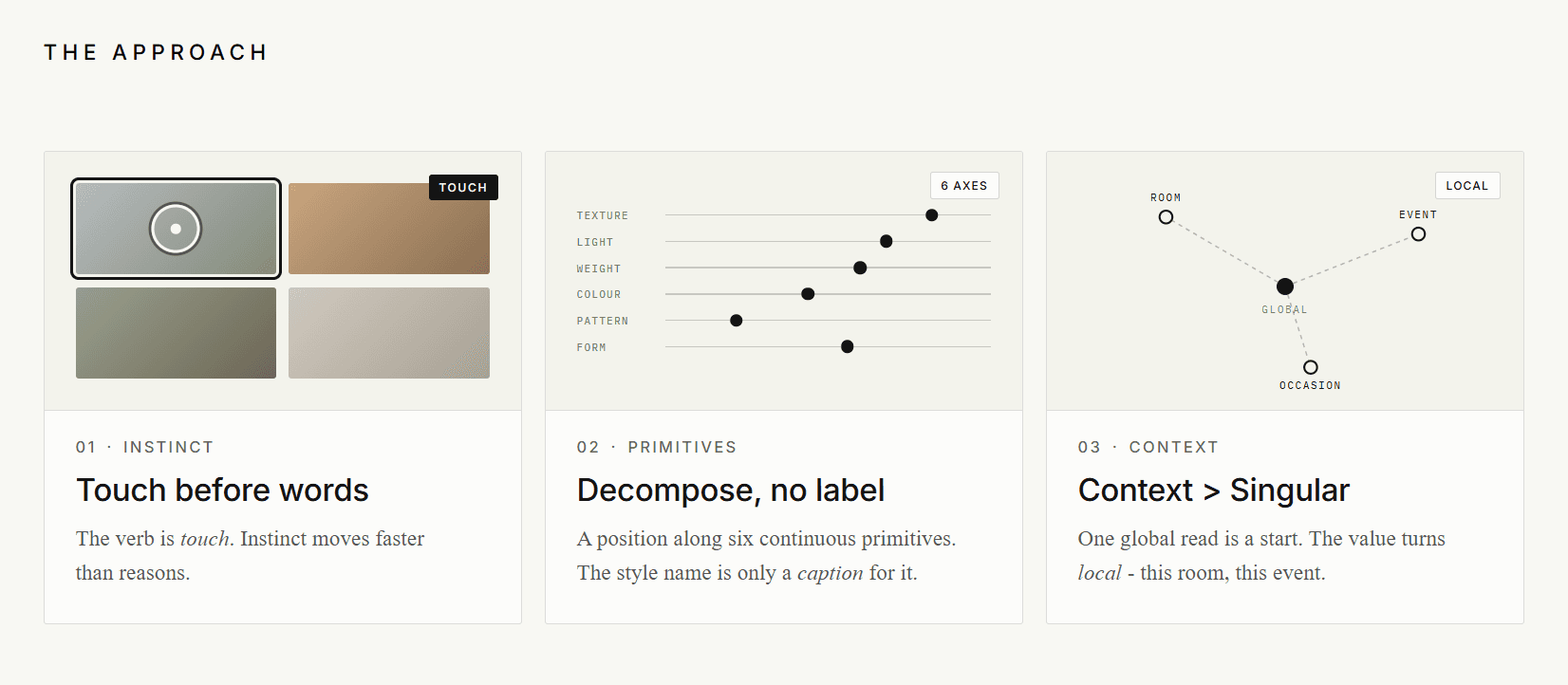
Touch before words, capture instinct by asking people to choose images; the verb is touch/feel, not rate or like, because it operates faster than rational thoughts.
Decompose, don't label, represent taste as a position along six continuous visual primitives (texture and light are two of them); a style name is treated as a readable caption for that position, not the thing itself.
Context over singular identity, one initial global read is just a starting point; over time, the real value becomes local: this room, this event, this occasion.
The hypothesis has grounding. Research in neuroaesthetics suggests individual responses to visual features stay consistent even when people cannot explain them, which mirrors my interview finding. Feature Integration Theory points to features being processed before objects. I approached both as hypotheses to test rather than fixed assumptions.
/ The Sandbox
Six Touches
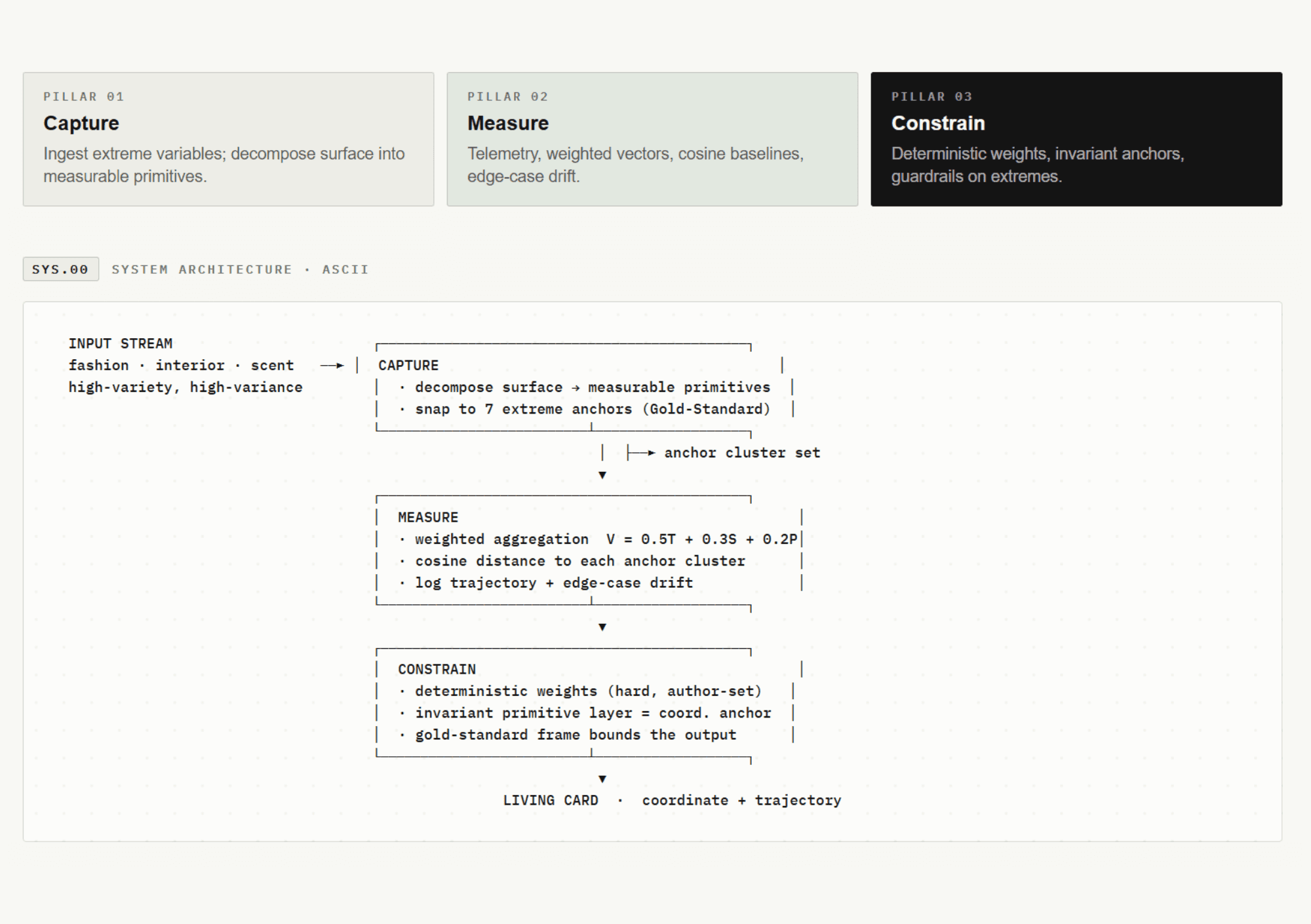
Capture is six comparative tests with sensory questions. "Touch the one that feels safe." "Which room lets you breathe?" The question underneath is whether untutored choices are coherent enough to build on. Touching an image registers the selection and advances the screen. A brief pause marks the threshold between input and result, pacing the transition intentionally.
The Living Card
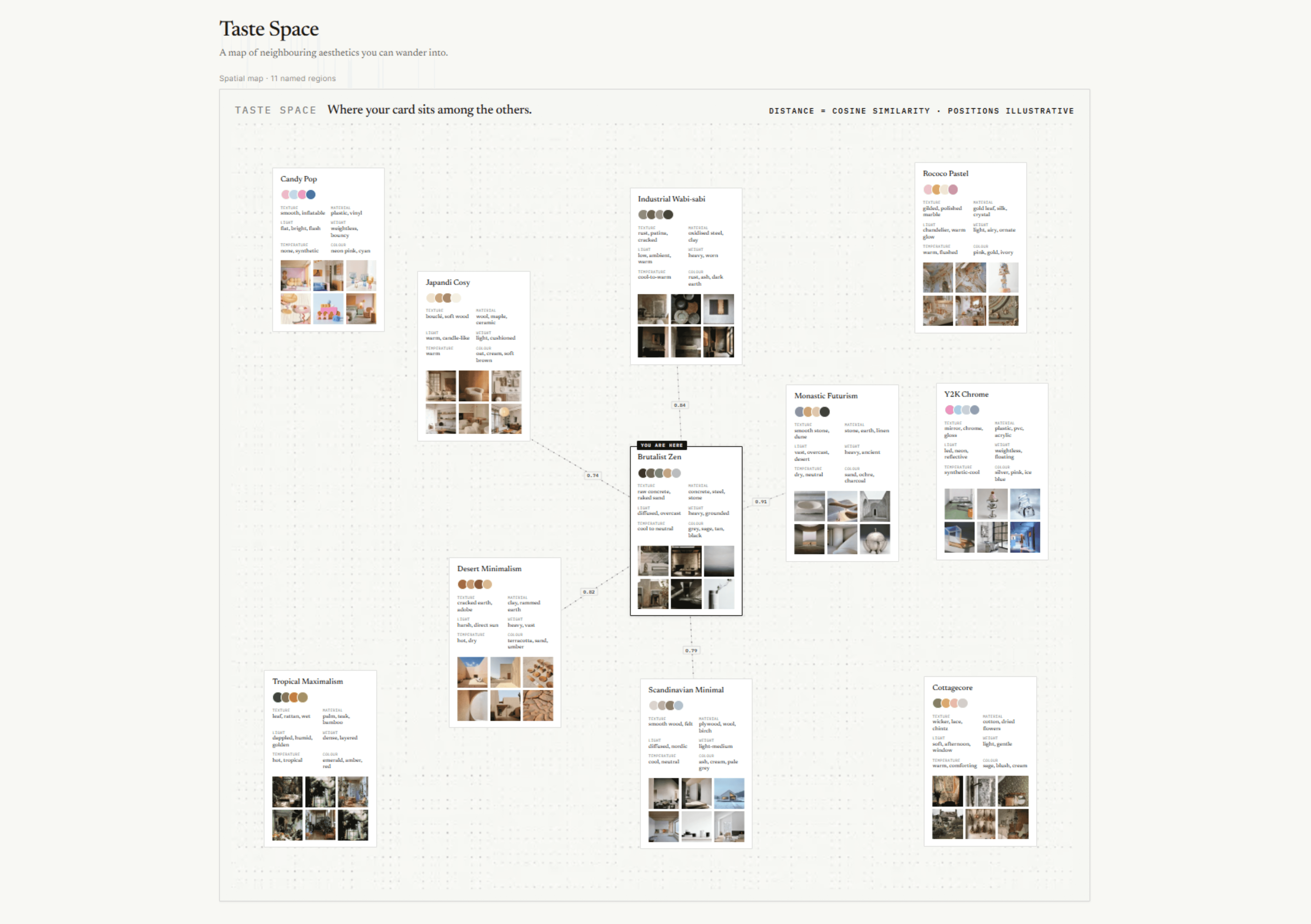
The result is a named aesthetic, for example, Brutalist Zen, over a ledger of primitive scores; the card includes a palette and adjacent directions to walk toward (discoverable through the Taste Space feature). The primitives are the values that the mechanism runs on. Over time, the card updates with every interaction, so it behaves like a record that evolves rather than a verdict that stays static.
Taste Space
The result is a position. A map of eleven named regions pins the user at YOU ARE HERE, nearest neighbours linked, similarity visible. Each region is a full territory with its own primitive profile, palette, and items across categories, readable at the same resolution as the user's own card. From there, exploration has real mechanics: step into a neighbouring region, see what it holds across scent, objects, and fashion, then adopt it as a card or blend it with the existing one. The intent is not just to tell users what they already like, but to give them legible adjacent directions to explore and grow into.
Cross-Category Retrieval
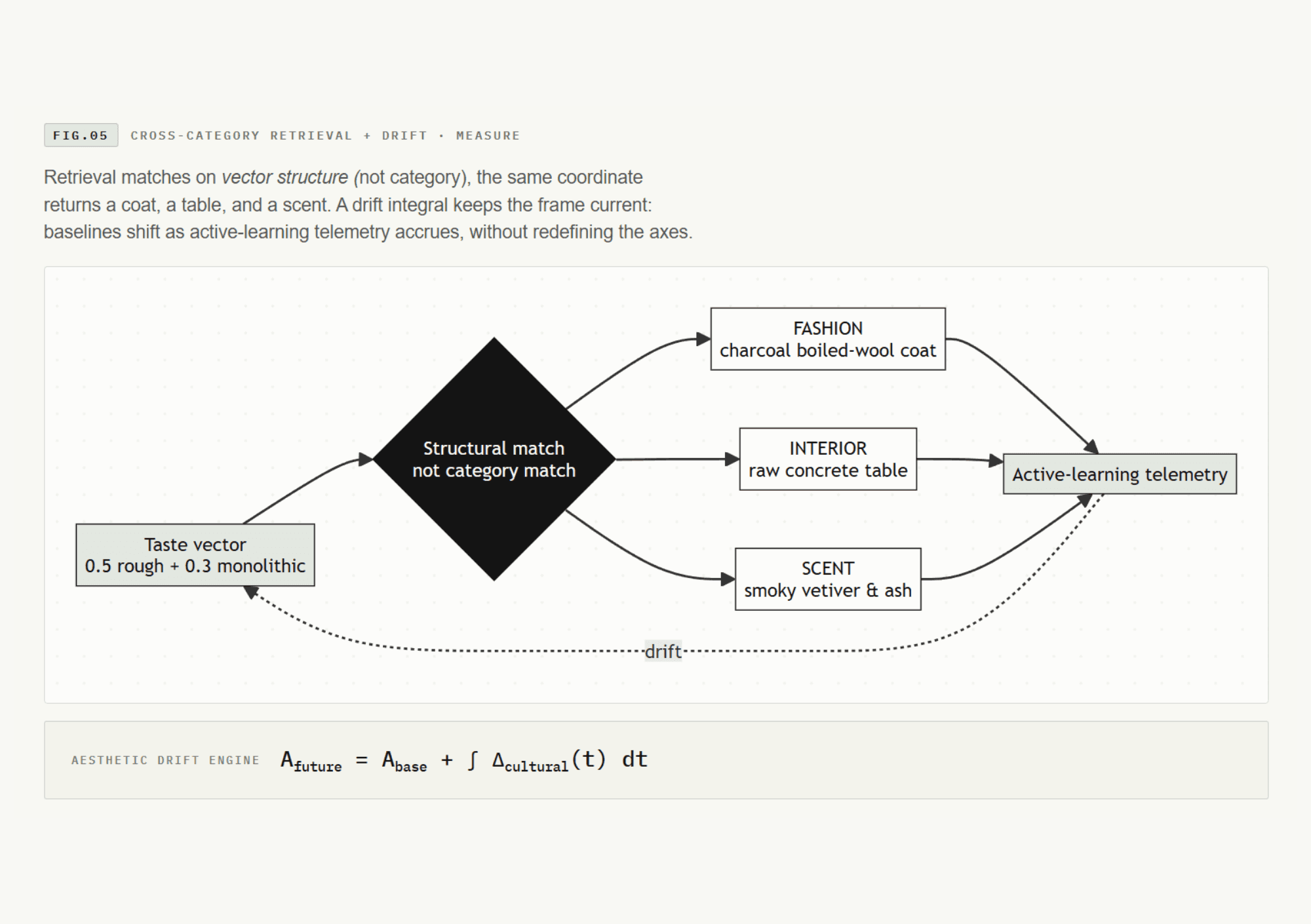
The boldest test of the idea: if the taste vector is real, it should cross categories. Recommendations score objects, fashion, and scent against the same profile, and in the visual-to-scent trial, scents are translated into primitives, directional results in reverse. The onscreen metric is calculated directly from user inputs, ensuring the underlying framework's data point serves a functional purpose.

Context Matters
Taste is highly contextual. An individual's preferences shift depending on their environment and immediate goals. While a global profile offers a useful starting point, it lacks the granularity needed for specific scenarios: a person's aesthetic choices for their bedroom will differ from their choices when hosting a party. The global card is a starting point that every situation-specific card is seeded from, and no situation should overwrite it.
Users create situational 'context cards' (e.g., Bedroom Decor, Dinner Party), which dynamically re-weight the same six core primitives rather than altering the baseline questions. It displays multiple divergent cards for a single user, capturing situational variance as valuable data.
For instance, a single item like a banana-leaf tablecloth might score 0.89 for a Tropical Maximalism dinner-party context but only 0.48 against the user's initial global card.
Rather than assigning a static stage and identity, NIVA maps preferences to specific scenarios. This structure directly addresses a common limitation of automated styling: algorithmic homogenisation, by structurally prioritising individual divergence.
/ Result
This stage demonstrates the core interaction and the underlying logic. Currently, vectors are manually structured to establish a baseline; a learned model is the natural next step. The map's layout is composed for visual legibility, and the catalogue acts as a seed.
NIVA is early and openly experimental. What it demonstrates is a way of turning humans' aesthetic preferences into something structured, legible and portable. This work serves as a logical prototype, establishing the foundational framework needed to transition toward a machine-learning model. The findings arriving next are the ones to be iterated on.
NIVA
Cross-Category Personalisation
Year
2026
Category
Creative Tech
Context
Independent R&D
/ Problem
The Articulation Gap
To explore our relationship with personal style and aesthetic, I initiated a research study comprising a survey of 50 participants and 10 in-depth interviews. The finding was that while people instinctively recognise what they love, they struggle to articulate and find objects/items that match it.
There's a strong desire to define and match their unique style, proving that while the instinct is deeply rooted, yet standard tools fall short in helping them break down, match, and interpret that intuitive taste.
Current recommendation systems haven't filled that gap yet. By modelling behaviour, clicks, purchases, and watch time, they flatten a person into their purchase history and cannot carry an aesthetic from one category to another. The tools that do attempt taste/style run a quiz and hand back one generic label: "minimalist," "boho," "maximalist." Broad style descriptors like 'minimalist' contain too much compressed data. They lack the granularity required to accurately match individual items, let alone capture a person's unique preferences.
Current AI stylists often shift the burden to the user by requiring written descriptions, the exact friction point for most consumers. While industries like fintech and healthcare scale rapidly on structured data, fashion lacks a foundational data layer for taste. Yet, consumer demand for visual consistency is surging, driven by younger demographics who treat aesthetic as identity. Digital wardrobe utility is peaking with 236% growth in a year, with users even improvising tools inside basic note apps, screenshots to save inspiration and grow their personal style.
The demand exists, and the tools that exist serve inspiration more than decisions.
/ The Insights
Core Principles
Three positions were laid out.
Touch before words, capture instinct by asking people to choose images; the verb is touch/feel, not rate or like, because it operates faster than rational thoughts.
Decompose, don't label, represent taste as a position along six continuous visual primitives (texture and light are two of them); a style name is treated as a readable caption for that position, not the thing itself.
Context over singular identity, one initial global read is just a starting point; over time, the real value becomes local: this room, this event, this occasion.
The hypothesis has grounding. Research in neuroaesthetics suggests individual responses to visual features stay consistent even when people cannot explain them, which mirrors my interview finding. Feature Integration Theory points to features being processed before objects. I approached both as hypotheses to test rather than fixed assumptions.
/ The Sandbox
Six Touches
Capture is six comparative tests with sensory questions. "Touch the one that feels safe." "Which room lets you breathe?" The question underneath is whether untutored choices are coherent enough to build on. Touching an image registers the selection and advances the screen. A brief pause marks the threshold between input and result, pacing the transition intentionally.
The Living Card
The result is a named aesthetic, for example, Brutalist Zen, over a ledger of primitive scores; the card includes a palette and adjacent directions to walk toward (discoverable through the Taste Space feature). The primitives are the values that the mechanism runs on. Over time, the card updates with every interaction, so it behaves like a record that evolves rather than a verdict that stays static.
Taste Space
The result is a position. A map of eleven named regions pins the user at YOU ARE HERE, nearest neighbours linked, similarity visible. Each region is a full territory with its own primitive profile, palette, and items across categories, readable at the same resolution as the user's own card. From there, exploration has real mechanics: step into a neighbouring region, see what it holds across scent, objects, and fashion, then adopt it as a card or blend it with the existing one. The intent is not just to tell users what they already like, but to give them legible adjacent directions to explore and grow into.
Cross-Category Retrieval
The boldest test of the idea: if the taste vector is real, it should cross categories. Recommendations score objects, fashion, and scent against the same profile, and in the visual-to-scent trial, scents are translated into primitives, directional results in reverse. The onscreen metric is calculated directly from user inputs, ensuring the underlying framework's data point serves a functional purpose.
Context Matters
Taste is highly contextual. An individual's preferences shift depending on their environment and immediate goals. While a global profile offers a useful starting point, it lacks the granularity needed for specific scenarios: a person's aesthetic choices for their bedroom will differ from their choices when hosting a party. The global card is a starting point that every situation-specific card is seeded from, and no situation should overwrite it.
Users create situational 'context cards' (e.g., Bedroom Decor, Dinner Party), which dynamically re-weight the same six core primitives rather than altering the baseline questions. It displays multiple divergent cards for a single user, capturing situational variance as valuable data.
For instance, a single item like a banana-leaf tablecloth might score 0.89 for a Tropical Maximalism dinner-party context but only 0.48 against the user's initial global card.
Rather than assigning a static stage and identity, NIVA maps preferences to specific scenarios. This structure directly addresses a common limitation of automated styling: algorithmic homogenisation, by structurally prioritising individual divergence.
/ Result
This stage demonstrates the core interaction and the underlying logic. Currently, vectors are manually structured to establish a baseline; a learned model is the natural next step. The map's layout is composed for visual legibility, and the catalogue acts as a seed.
NIVA is early and openly experimental. What it demonstrates is a way of turning humans' aesthetic preferences into something structured, legible and portable. This work serves as a logical prototype, establishing the foundational framework needed to transition toward a machine-learning model. The findings arriving next are the ones to be iterated on.
NIVA
Cross-Category Personalisation
Year
2026
Category
Creative Tech
Context
Independent R&D
/ Problem
The Articulation Gap
To explore our relationship with personal style and aesthetic, I initiated a research study comprising a survey of 50 participants and 10 in-depth interviews. The finding was that while people instinctively recognise what they love, they struggle to articulate and find objects/items that match it.
There's a strong desire to define and match their unique style, proving that while the instinct is deeply rooted, yet standard tools fall short in helping them break down, match, and interpret that intuitive taste.
Current recommendation systems haven't filled that gap yet. By modelling behaviour, clicks, purchases, and watch time, they flatten a person into their purchase history and cannot carry an aesthetic from one category to another. The tools that do attempt taste/style run a quiz and hand back one generic label: "minimalist," "boho," "maximalist." Broad style descriptors like 'minimalist' contain too much compressed data. They lack the granularity required to accurately match individual items, let alone capture a person's unique preferences.
Current AI stylists often shift the burden to the user by requiring written descriptions, the exact friction point for most consumers. While industries like fintech and healthcare scale rapidly on structured data, fashion lacks a foundational data layer for taste. Yet, consumer demand for visual consistency is surging, driven by younger demographics who treat aesthetic as identity. Digital wardrobe utility is peaking with 236% growth in a year, with users even improvising tools inside basic note apps, screenshots to save inspiration and grow their personal style.
The demand exists, and the tools that exist serve inspiration more than decisions.
/ The Insights
Core Principles
Three positions were laid out.
Touch before words, capture instinct by asking people to choose images; the verb is touch/feel, not rate or like, because it operates faster than rational thoughts.
Decompose, don't label, represent taste as a position along six continuous visual primitives (texture and light are two of them); a style name is treated as a readable caption for that position, not the thing itself.
Context over singular identity, one initial global read is just a starting point; over time, the real value becomes local: this room, this event, this occasion.
The hypothesis has grounding. Research in neuroaesthetics suggests individual responses to visual features stay consistent even when people cannot explain them, which mirrors my interview finding. Feature Integration Theory points to features being processed before objects. I approached both as hypotheses to test rather than fixed assumptions.
/ The Sandbox
Six Touches
Capture is six comparative tests with sensory questions. "Touch the one that feels safe." "Which room lets you breathe?" The question underneath is whether untutored choices are coherent enough to build on. Touching an image registers the selection and advances the screen. A brief pause marks the threshold between input and result, pacing the transition intentionally.
The Living Card
The result is a named aesthetic, for example, Brutalist Zen, over a ledger of primitive scores; the card includes a palette and adjacent directions to walk toward (discoverable through the Taste Space feature). The primitives are the values that the mechanism runs on. Over time, the card updates with every interaction, so it behaves like a record that evolves rather than a verdict that stays static.
Taste Space
The result is a position. A map of eleven named regions pins the user at YOU ARE HERE, nearest neighbours linked, similarity visible. Each region is a full territory with its own primitive profile, palette, and items across categories, readable at the same resolution as the user's own card. From there, exploration has real mechanics: step into a neighbouring region, see what it holds across scent, objects, and fashion, then adopt it as a card or blend it with the existing one. The intent is not just to tell users what they already like, but to give them legible adjacent directions to explore and grow into.
Cross-Category Retrieval
The boldest test of the idea: if the taste vector is real, it should cross categories. Recommendations score objects, fashion, and scent against the same profile, and in the visual-to-scent trial, scents are translated into primitives, directional results in reverse. The onscreen metric is calculated directly from user inputs, ensuring the underlying framework's data point serves a functional purpose.
Context Matters
Taste is highly contextual. An individual's preferences shift depending on their environment and immediate goals. While a global profile offers a useful starting point, it lacks the granularity needed for specific scenarios: a person's aesthetic choices for their bedroom will differ from their choices when hosting a party. The global card is a starting point that every situation-specific card is seeded from, and no situation should overwrite it.
Users create situational 'context cards' (e.g., Bedroom Decor, Dinner Party), which dynamically re-weight the same six core primitives rather than altering the baseline questions. It displays multiple divergent cards for a single user, capturing situational variance as valuable data.
For instance, a single item like a banana-leaf tablecloth might score 0.89 for a Tropical Maximalism dinner-party context but only 0.48 against the user's initial global card.
Rather than assigning a static stage and identity, NIVA maps preferences to specific scenarios. This structure directly addresses a common limitation of automated styling: algorithmic homogenisation, by structurally prioritising individual divergence.
/ Result
This stage demonstrates the core interaction and the underlying logic. Currently, vectors are manually structured to establish a baseline; a learned model is the natural next step. The map's layout is composed for visual legibility, and the catalogue acts as a seed.
NIVA is early and openly experimental. What it demonstrates is a way of turning humans' aesthetic preferences into something structured, legible and portable. This work serves as a logical prototype, establishing the foundational framework needed to transition toward a machine-learning model. The findings arriving next are the ones to be iterated on.